About Hassler Cell
TOP INDUSTRIE has been developing technical means for researchcentres working in the following areas:
- Geomechnical tests under pressure on soils, rocks, cements abd concrete.
- Triaxial tests in fissuring, drainage, permeation, percolation, creep..
- Measures of displacemrnt, dilation, flow
Features
- Easy to use, inexpensive.
- Makes permeability tests easy to carry out.
- Internal temperature monitoring.
- PED 97/23/EC Compliant.
- Closure through conical shutter and screwed in cylinder head.
- Confinement pressure control.
- Control of upstream and downstream draining pressure.
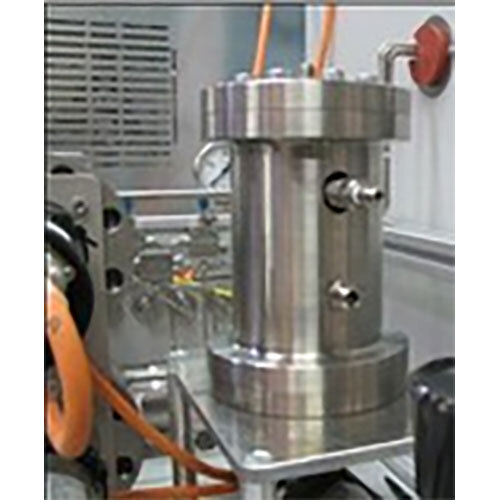
Precision Engineering for Laboratory Filtration StudiesThe Hassler Cell is meticulously engineered to deliver reliable liquid permeability readings of various testing materials, including filter papers, membranes, and nonwovens. With a control mode supporting both manual and pneumatic operation, users have flexibility to suit specific experimental needs. Its corrosion-resistant chamber and robust construction assure long-term performance, while the analog graduated scale grants immediate monitoring and precise control during experiments.
User-Centric Design for Clear Observation and Easy MaintenanceThanks to its transparent borosilicate glass chamber, users can seamlessly observe fluid flow and filtration dynamics in real time. Mounting and replacing test specimens is straightforward due to the easy specimen holder system, and the fully disassemblable structure allows thorough, hassle-free cleaning after each test. The inclusion of a safety pressure relief valve and screw-on cap with O-ring ensures safe operating conditions up to 3 bar pressure.
FAQs of Hassler Cell:
Q: How does one operate the Hassler Cell for permeability testing?
A: To operate the Hassler Cell, mount the test specimen (up to 25 mm in diameter) into the holder, secure the screw-on cap with the O-ring for a proper seal, and fill the chamber with the desired test liquid. Depending on your setup, you can use manual or pneumatic pressureup to 3 barwhile observing the flow through the graduated scale for direct measurement.
Q: What types of materials can be tested with this equipment?
A: The Hassler Cell is applicable for liquid permeability testing of paper, membrane filters, nonwoven substrates, and other filtration media. It is ideal for materials that require precision flow measurement within the 0.55 ml/min range.
Q: When should the cleaning process be conducted, and how is it accomplished?
A: Cleaning should be performed after each test run to prevent cross-contamination and residue build-up. The cell fully disassembles, enabling each componentincluding the borosilicate glass chamber and stainless steel fittingsto be cleaned thoroughly and reassembled quickly for the next test.
Q: Where is this Hassler Cell typically used?
A: This instrument is most commonly used in laboratory settings, particularly within research, quality control, or production labs focused on evaluating the fluid retention or permeability characteristics of filter media and similar materials.
Q: What safety features are included with the Hassler Cell?
A: For user safety, the Hassler Cell incorporates a pressure relief valve to protect against accidental over-pressurization. It also features a secure screw-on cap with O-ring sealing, ensuring a leak-proof and safe testing environment.
Q: How does the transparent construction benefit the testing process?
A: The transparent borosilicate glass chamber enables users to closely visualize fluid movement and detect any irregularities or blockages in real time, enhancing test accuracy and facilitating immediate troubleshooting if necessary.
Q: What are the main advantages of using this equipment in the lab?
A: The Hassler Cell offers precise, reproducible permeability measurements, straightforward specimen handling, immediate visual feedback, a corrosion-resistant build for longevity, and easy cleaningall without requiring a power supply, making it a practical, reliable, and user-friendly choice for laboratory environments.








 Send Inquiry